
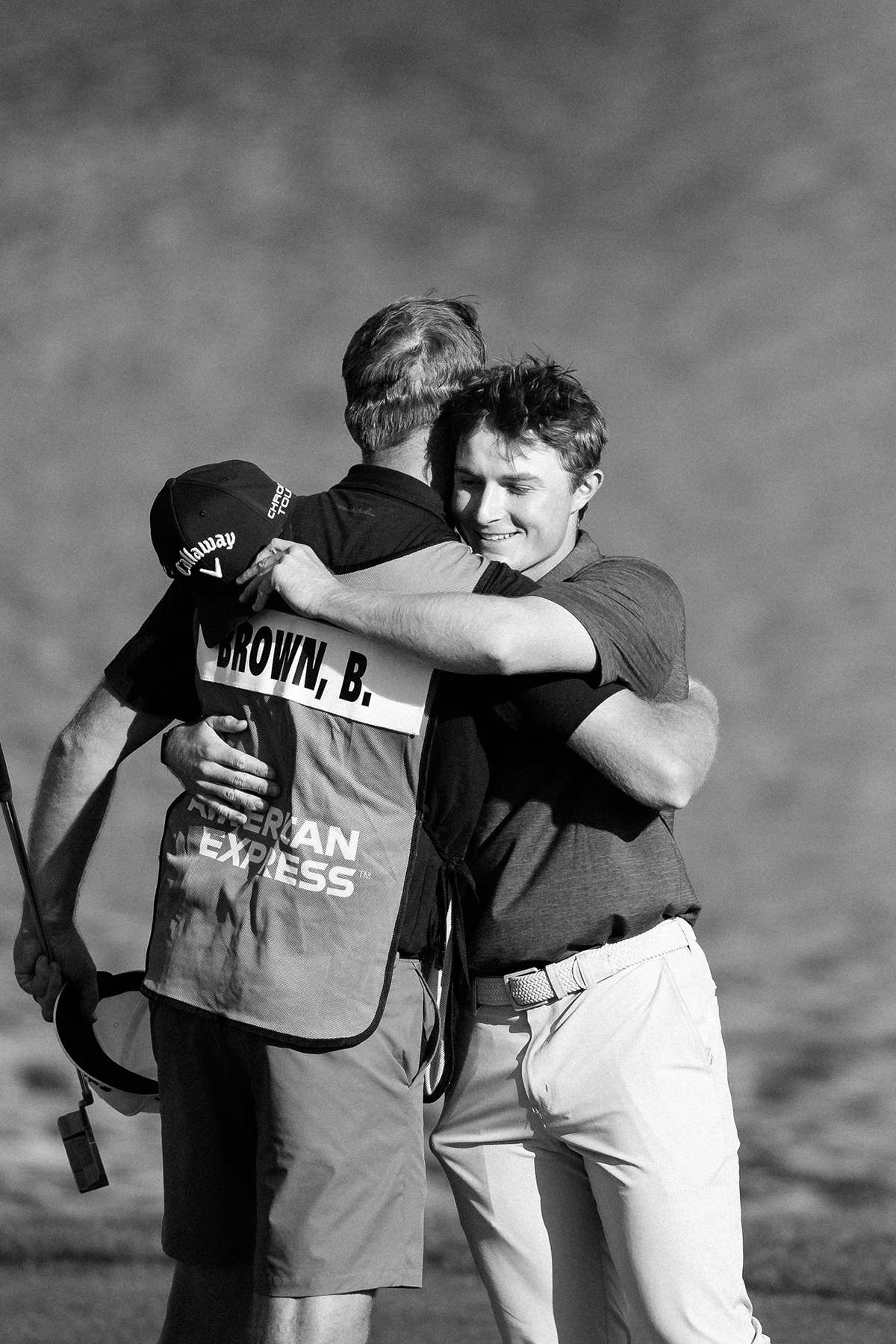
Editor’s Note: An 18-year-old shooting 67-60-68 to get into the final group with Scottie Scheffler? Blades Brown, you officially have the golf world’s attention. We recently sat down with Brown’s coach, Justin Parsons, for Episode #191 of the TGJ Podcast. Parsons spoke candidly about modern player development and the realities young players like Brown face once the spotlight finds them. What follows is a lightly edited excerpt from that conversation, centered on how much the PGA Tour’s entry point has shifted and how these young phenoms are no longer anomalies. They are more prepared, stronger and comfortable with the spotlight than teenagers of golf’s past. But in Parsons’ view, there’s a potential caveat: The definition of a long career in golf may be changing along with them.—The Golfer’s Journal.
Casey Bannon: You have two very exciting young players in Blades Brown and Aldrich Potgieter. Why do young players today seem so much more prepared to compete at the highest level?
Justin Parsons: I think they’re simply better at golf at a younger age. They’re better coached, and the information available to them is dramatically better. Even outside of elite coaching environments, the baseline knowledge coming from parents, clubs, and instructors is much higher than it used to be.
You also see acceleration happen earlier. A 14-, 15-, or 16-year-old can now look around and say, I see Rory in the gym. I see Scottie doing Golf Forever. I see how the best players train. That changes behavior. Launch monitors have helped enormously as well. They’ve narrowed the margins and allowed young players to understand their parameters much earlier.
Blades is a great example. He reached 17 or 18 and decided college wasn’t something he necessarily needed to do. As careers potentially shorten because of prolonged mental and physical attrition, we may start seeing players come out at 18 or 19 and finish at 31 or 32, similar to other professional sports.
I don’t think we’re going to see many careers like Bernhard Langer’s anymore. He turned professional at 18 or 19 and is still competing at a high level almost into his 70s. That’s something the next generation of commissioners, along with the USGA, R&A and LIV, will have to navigate. The sport has become far more athletic.
Aldrich [Potgieter] is living proof of that. He’s incredibly powerful. But he’s also more authentic. He’s been well trained, but there’s a certain rawness to his game—and some constraints, particularly in distance control—that we’re actively working on.
We’re reaching a point in 2025 where we have to ask: If a young player has 200-mph ball speed, how do you actually caddie for that? What do you do with a 7-iron into a light wind from 178 yards when your gapping between clubs is 26 yards and you’re right in that 13-yard window? That’s a real problem.
We’ve looked at 184-186 mph ball speed as a more optimal upper window for an elite competitive player. I’m sure there are pitchers in baseball who can throw 100, but that doesn’t mean they’re the most effective. Versatility matters.
This isn’t about slowing down. It’s about recognizing that if you’re living at 200, you’re going to have holes in your game. Aldrich can still get to 200 when he wants it, but his cruising speed might be closer to 185.
He told me recently that there are bunkers at 327 yards where he’s playing, and with the right wind he can comfortably carry it 330, 335 yards. That’s extraordinary. But then you have to ask: What happens at 176 yards? He’s still hitting a 9-iron. So what does he do at 154?
That’s where you make money in professional golf. Controlling the golf ball from the fairway is where careers are made. Look at someone like Lucas Glover—he might be 168 mph now, but he controls the golf ball as well as anyone, and he’s having a real Indian summer in his career.
Things are changing. My hope is that we do a better job protecting young players when they inevitably hit the downward wave that every career has. Nick Dunlap is going through that right now. It’s hard, very public and very embarrassing. Gordon Sargent is hopefully coming through his own version of it. Those guys are getting good swing advice, but it’s hard to do that when you’re young.
Those phases are unavoidable. They happen to everyone. I saw it with Harris English and Lee Westwood. They happen whether you’re young or already established.
The challenge now is that young players are growing up in a world of smartphones, anxiety and constant scrutiny. When that downturn comes, we need to help them understand it’s not the end of the world. They’re gifted. They still have an extreme level of talent.
CB: Do you think that downturn is inevitable for most players?
JP: Yes. If you look at Data Golf and study long careers like Adam Scott’s, there are always waves. In Scottie Scheffler’s case, it’s problems with the putter. In Tiger’s case it could be an injury. Sometimes it’s personal life. Those little waves are inevitable as you go through your career.
Young players get to the PGA Tour and suddenly the fairways are narrower, the greens are firmer, the hole locations are tighter and nothing is quite going where they’re looking. Add crowds, media, questions, expectations—it’s a lot of added pressure.
That’s why I think the Korn Ferry Tour is a valuable breeding ground. There’s even an argument that nobody over 40 should be playing on it, and that the Champions Tour should return to age 45. That might balance things better.
But it’s complicated. You still see players like Stewart Cink winning, and you see young players like Nick [Dunlap] come out and win immediately. We want to make sure we don’t level it too hard.
CB: You mentioned careers potentially being shorter. Is that tied to athleticism?
JP: One hundred percent. Bernhard Langer is a fabulous player. I’ve learned a great deal from him and admired him throughout my life. But Bernard never hit it hard. He was a precision player. If you start applying the levels of torque and force we see today onto the human body, there’s a physical cost.
We’ll continue to improve training, nutrition and periods of rest to rebalance. But the “balls to the wall, hit it as far as we can” approach coming out of college has consequences—loss of equipment control, approach-shot precision, mental sharpness and physical durability.
Listen to the full conversation with Justin Parsons on TGJ Podcast #191 on Spotify or Apple Podcasts.


